
The 8 Best Somatic Therapy Exercises for Holistic Health
The best somatic therapy exercises are simple, body-first practices such as slow belly breathing, progressive muscle relaxation and a body scan, which help you notice where your body holds physical tension and then let it go. Most take 10 minutes or less, need no equipment and work in a chair, on the floor or standing up.
The catch is that 'somatic' has become a social media label for almost any movement, and the evidence behind each exercise varies widely. Progressive muscle relaxation has been tested in dozens of studies, while other somatic techniques rest mainly on practitioner experience. Choosing blindly wastes time, and for people who have experienced trauma, some relaxation techniques can bring up uncomfortable feelings rather than calm (Mayo Clinic).
This guide grades the evidence for each exercise so you can pick the right one for the moment.
What are somatic therapy techniques?
Somatic therapy techniques are body-based methods that use breath, movement and attention to physical sensations to work with how stress and emotion show up in the body. Harvard Health describes somatic therapy as 'a treatment focusing on the body and how emotions appear within the body' (Harvard Health Publishing, July 2023). Somatic therapy is built on the mind body connection. Talk therapy, such as cognitive behavioural therapy (CBT), starts with thoughts; somatic work is a body focused therapy that takes a bottom up approach and starts with bodily sensations. The psychologist Harvard Health interviewed still suggests CBT as a starting point, because it has stronger research support.
In a clinical setting, a trained therapist guides techniques such as pendulation (moving between a calm state and a difficult feeling, then back), titration (working through a memory in small steps while tracking physical sensations) and resourcing (recalling people and places that feel safe). Somatic Experiencing, developed by Peter Levine, and body psychotherapy are two of the best-known forms of this therapeutic approach, alongside other forms such as sensorimotor psychotherapy. Somatic therapists often describe their goal as nervous system regulation and better emotional regulation.
What are somatic therapy exercises?
Somatic therapy exercises are the self-guided versions of these techniques, body based practices such as breathing exercises, body scans, grounding techniques and gentle movements you can practise at home to build body awareness and ease muscle tension in everyday life. When chronic stress shows up as physical symptoms such as a tight jaw or raised shoulders, these body based tools give you a greater sense of where tension sits. They are self-care, not a substitute for somatic therapy work with a somatic therapist.
These home exercises are not a treatment for post traumatic stress disorder, panic attacks, anxiety disorders or chronic pain. If you have experienced trauma, live with PTSD symptoms, or find that stress levels are affecting your mental health, speak to your GP or refer yourself to NHS Talking Therapies. Trauma recovery is work for a qualified mental health professional.
How we chose the 8 best somatic exercises
The 8 best somatic exercises in this guide were shortlisted from the leading UK guides, NHS and hospital trust guidance, and published research, using four criteria. Each exercise had to:
Need no equipment and work in a chair, on the floor or standing.
Take 10 minutes or less (15 at most for a full-body version).
Have published guidance from the NHS, a hospital trust or peer-reviewed research behind it.
Carry low physical risk for most adults when done gently.
We then graded the evidence for each one. Most top-ranking guides list somatic techniques for stress relief side by side without saying which have been tested and which are simply popular, so the table below separates the two and lets you weigh the potential benefits of each.
| Somatic exercise | Time | Best moment to use it | Evidence behind it |
|---|---|---|---|
| 1. Belly breathing with a slow count | 5 minutes | Start or end of the working day | NHS self-help guidance |
| 2. Cyclic sighing | 5 minutes | After a tense meeting or commute | One randomised trial, 108 adults (2023) |
| 3. Progressive muscle relaxation | 10 to 15 minutes | Winding down before bed | Systematic review of 46 studies (2024) |
| 4. Body scan | 5 to 10 minutes | Finding where you hold tension | Core practice in NHS-recognised mindfulness |
| 5. Five senses grounding | 2 to 3 minutes | When racing thoughts make it hard to settle | Widely used by therapists; few trials |
| 6. Slow contract and release | 5 minutes | Stiffness after long periods of sitting | Practitioner method (Thomas Hanna); few trials |
| 7. Gentle rocking and swaying | 2 to 5 minutes | Restless energy you cannot sit still with | Practitioner guidance; few trials |
| 8. Orienting and resourcing | 2 to 3 minutes | Settling into a busy or unfamiliar space | Used within somatic therapy; few trials |
Short answer: the best-evidenced somatic exercises are progressive muscle relaxation and slow breathing with a long exhale. Both take 5 to 15 minutes and need no equipment.
1. Belly breathing with a slow count
Belly breathing with a slow count is the simplest somatic exercise: you breathe deep into your abdomen, counting to 5 on the in-breath and 5 on the out-breath, for at least 5 minutes. The NHS recommends this exact method in its breathing exercise for stress.
Loosen any tight clothing, then sit, stand or lie down with your feet flat and about hip-width apart.
Breathe in through your nose and let the breath flow down into your belly, without forcing it.
Breathe out gently through your mouth.
Count from 1 to 5 on each in-breath and each out-breath if counting helps. You may not reach 5 at first.
Keep going for at least 5 minutes.
The NHS notes that you get the most benefit by practising regularly, as part of your daily routine. Slow breathing with a longer exhale is widely linked to the parasympathetic nervous system, the 'rest and digest' side of the body's stress response, which is why many people find it a calm starting point.
2. Cyclic sighing
Cyclic sighing is a breathing pattern of two inhales through the nose followed by one long, slow exhale, repeated for 5 minutes. In a 2023 Stanford study published in Cell Reports Medicine, 108 adults practised one of four techniques for 5 minutes a day over 28 days, and cyclic sighing lowered breathing rate more than mindfulness meditation.
Sit or lie down and set a timer for 5 minutes.
Inhale slowly through your nose.
Take a second, shorter inhale to fill your lungs fully.
Exhale slowly and completely through your mouth.
Repeat until the timer ends, then return to normal breathing.
The study authors point out its limits: a small sample, remote delivery and only four weeks of follow-up. Treat cyclic sighing as a promising short reset rather than a proven fix. If you feel light-headed, slow down or switch back to normal breathing.
3. Progressive muscle relaxation
Progressive muscle relaxation (PMR) is the most researched somatic technique on this list: you tense each muscle group for 5 to 10 seconds, release it, and notice the difference. American physician Edmund Jacobson developed PMR in the 1920s, long before 'somatic' became a wellness term.
A February 2024 systematic review in Psychology Research and Behavior Management analysed 46 studies covering more than 3,402 adults in 16 countries. It found PMR helped reduce self-reported stress, with stronger results when PMR was combined with other relaxation techniques. University College London Hospitals sets out the method below (UCLH).
Lie down comfortably, close your eyes and focus on your breathing.
Breathe in and tense the muscles in your feet for 5 to 10 seconds.
Breathe out, relax your feet and notice the tension releasing.
Repeat, adding one muscle group at a time: calves, thighs, hips and glutes, stomach, chest, shoulders, upper arms, forearms, hands, neck, then head and face.
Finish with your eyes closed, breathing slowly and keeping your muscles relaxed.
Tense gently rather than at full strength, and skip any area that is painful. A shortened version focusing on the shoulders, hands, jaw and neck takes about 4 minutes and suits a desk break.
4. Body scan
A body scan is a mindfulness exercise in which you move your attention slowly from your toes to the top of your head, noticing bodily sensations without trying to change them. The NHS describes reconnecting with the body and the sensations it experiences as 'an important part of mindfulness' (NHS).
Lie down or sit with your back supported and close your eyes.
Bring your attention to your toes and notice warmth, pressure, tingling or nothing at all.
Move slowly upwards through your feet, legs, hips, stomach, chest, hands, arms, shoulders, neck, jaw and face.
Pause wherever you notice physical tension, breathe into that area, and move on.
A body scan works well as a diagnostic: the places your body holds tension, often a clenched jaw, raised shoulders or tight hands, are the places to target with PMR. Approach whatever you find with self compassion rather than judgement; this holistic approach to well being is about noticing, not fixing.
5. Five senses grounding (5, 4, 3, 2, 1)
Five senses grounding is a 2 to 3 minute exercise that brings your attention to the present moment by naming 5 things you can see, 4 you can feel, 3 you can hear, 2 you can smell and 1 you can taste. Therapists widely use it as one of the core grounding techniques, although it has few formal trials of its own.
Start by pressing your feet into the floor and noticing the contact with your chair, which the Priory recommends as a simple grounding step. Then work down the count. Many people reach for this exercise when racing thoughts make it hard to settle, because it needs no space and nobody around you will notice.
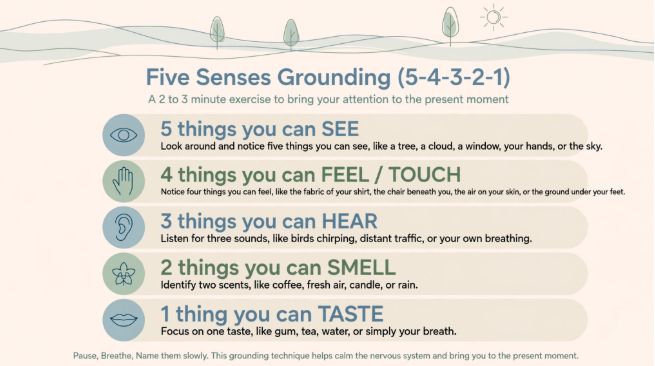
How to ground through the 54321 method
6. Slow contract and release (pandiculation)
Pandiculation is a slow, voluntary contract-and-release movement modelled on the stretch and yawn people make on waking, and it sits at the core of Thomas Hanna's Clinical Somatic Education (Yoga U). It differs from stretching because you contract the muscle first, then release it very slowly while paying attention.
Lie on your back with your knees bent and feet flat on the floor.
Over about 5 seconds, gently arch your lower back so it lifts slightly from the floor.
Over 5 to 10 seconds, slowly flatten your lower back towards the floor until the muscles are soft.
Rest for a few breaths and notice how your back feels.
Repeat 3 to 5 times.
Keep the movement small and slow. If you have back pain, have it assessed before starting, and stop any movement that hurts.
7. Gentle rocking and swaying
Gentle rocking is a rhythmic, low-effort movement, such as swaying side to side while standing or rocking forward and back in a chair, kept up for 2 to 5 minutes. The Priory lists rocking, gentle twisting at the waist and light bouncing on the balls of your feet as options.
This form of mindful movement suits restless energy that makes sitting still feel impossible. Somatic shaking, popular on social media, is a more vigorous version; the evidence for shaking is anecdotal, so keep it gentle and stop if you feel dizzy.
8. Orienting and resourcing
Orienting and resourcing are two techniques borrowed from somatic therapy: orienting means slowly turning your head and eyes to take in your surroundings, and resourcing means recalling a person or place that feels calm and safe (Harvard Health).
Sit comfortably and let your eyes move slowly around the room, resting on anything that catches your interest.
Turn your head gently as you look, noticing colours, shapes and light.
Bring to mind a calm place, real or imagined, and picture what you see, hear and feel there.
Stay with the image for a few breaths, then open your eyes or return your attention to the room.
The visualisation steps follow the UCLH relaxation guidance, which suggests building the scene one sense at a time.
A 10 minute somatic routine for everyday tension
A 10 minute somatic routine that combines three exercises covers breathing, muscle tension and body awareness in one session, and it is the sequence to try first.
Spend minutes 0 to 3 on belly breathing with a slow count.
Spend minutes 3 to 8 on shortened PMR: shoulders, hands, jaw and neck.
Spend minutes 8 to 10 on a quick body scan, noticing what changed.
For a 3 minute somatic exercise, do 1 minute of cyclic sighing, 1 minute of five senses grounding and 1 minute of orienting. That version fits between meetings or before a difficult phone call.
Are somatic exercises safe?
Somatic exercises are safe for most adults when done gently, but they are not right for everyone in every situation. The Mayo Clinic notes that people with serious mental health issues or a history of abuse or trauma may feel emotional discomfort during some relaxation techniques, and advises stopping and speaking to a professional if that happens.
Pause, adapt or skip any exercise that brings up uncomfortable physical sensations or feelings, as the Priory advises.
Stop breathing exercises if you feel dizzy or light-headed.
Stop any movement that causes pain.
Work with a trained therapist, not a self-guided routine, if you have experienced traumatic events or traumatic experiences still affect you.
Keep taking any treatment or medication you have been prescribed; somatic exercises can sit alongside care for your physical health and mental health but do not replace it.
When to see a professional about physical tension
A professional assessment makes sense when muscle tension keeps returning to the same place or comes with pain that limits what you can do. At Sona, our General Chiropractic Council registered chiropractors assess and treat mechanical neck pain, back pain, muscle spasms and tension that makes it hard to relax, and our massage therapists work with general aches and pains.
Start with one exercise tonight
Pick one exercise from the table and practise it for 5 minutes a day for a week before adding another; belly breathing is the easiest place to start. If the same tension keeps coming back despite regular practice, book an assessment with Sona so a chiropractor can check what is behind it.
Common questions about somatic exercises
Do somatic exercises actually work?
Somatic exercises vary in evidence, and research shows the gap is wide: progressive muscle relaxation and slow breathing have the strongest research behind them, while shaking, rocking and orienting rest mainly on practitioner experience. Harvard Health notes that little scientific research has examined somatic therapy as a whole, so judge each exercise on its own evidence.
What is the most effective somatic technique?
Progressive muscle relaxation has the strongest evidence base of the common somatic techniques, supported by a 2024 systematic review of 46 studies. Its effects were stronger when combined with other relaxation methods, such as slow breathing.
Can somatic exercises release trauma?
Self-guided somatic exercises are not a trauma treatment. Trauma-focused somatic therapy is delivered by a qualified therapist, and the NHS offers evidence-based trauma support through your GP or NHS Talking Therapies.
