
7 Nervous System Benefits of Chiropractic Care for Children
Chiropractic care for children supports 7 key dimensions of nervous system function: healthy neural development, sleep quality, digestive regulation, immune resilience, stress response, sensory processing, and recovery from birth-related tension. These benefits emerge from chiropractic's influence on the spine and spinal cord, the primary communication pathway between the brain and every organ, tissue, and system in a child's growing body.
Parents seeking chiropractic care for their children often arrive with one specific presenting concern: poor sleep, unsettledness, feeding difficulties, or a preference for turning the head to one side. What they frequently discover is that addressing nervous system function at the spinal level produces changes that extend far beyond the original reason for booking. This is not incidental. The nervous system governs the whole of a child's development, and when it functions well, children tend to thrive across multiple dimensions at once.
This article explains what the nervous system benefits of chiropractic care for children actually are, why they matter at each stage of development from newborn to toddler and beyond, and what families across Angus and Perthshire can expect when they bring a child to Sona Chiropractic.
Why the Nervous System Is Central to Children's Health
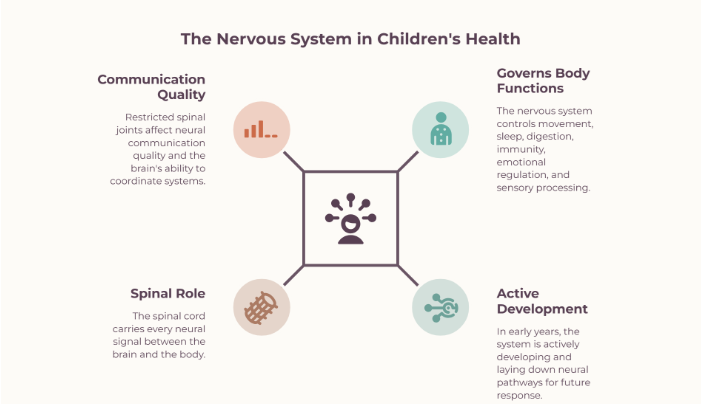
The nervous system governs everything in a child's body: movement, sleep, digestion, immunity, emotional regulation, and sensory processing. In the early years of life, the nervous system is not simply functioning. It is actively developing, laying down the neural pathways that will shape how a child's body and brain respond to the world for decades to come.
The spine plays a critical role in this process. The spinal cord, housed within the spinal column, carries every neural signal between the brain and the body. When spinal joints become restricted or move abnormally, whether from the physical forces of birth, the demands of early motor development, or the cumulative effect of growth, the quality of neural communication is affected. The brain receives a less accurate picture of the body's state, and its ability to coordinate the child's developing systems is diminished.
This is why chiropractors who work with children focus not on force or structural correction but on restoring the quality of nervous system communication. The adjustment techniques used with babies and young children bear no resemblance to those used with adults. Pressure applied to an infant's spine is no greater than the weight of a fingertip, approximately 5 grams, adapted entirely to the sensitivity and development stage of the child.
For a fuller explanation of how chiropractic supports the nervous system at any age, our guide to holistic chiropractic care covers the underlying science in detail.
What Are the Key Nervous System Benefits of Chiropractic for Children?
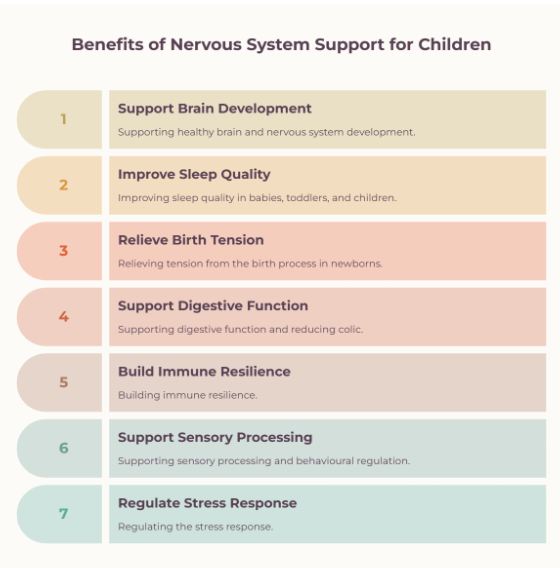
Benefit 1: Supporting Healthy Brain and Nervous System Development
Chiropractic care for children supports nervous system development by improving the quality of sensory input reaching the brain during the critical early years of neural pathway formation. The brain builds its map of the body through sensory information received from the joints, muscles, and spinal cord. When spinal function is optimal, that map is accurate, detailed, and reliable. When it is compromised, the brain's ability to coordinate the body's developing systems is reduced.
A 2016 study published in the journal Neural Plasticity by Lelic, Haavik, and colleagues at the New Zealand College of Chiropractic demonstrated that spinal adjustments of dysfunctional spinal joints produce measurable changes in sensorimotor integration, including reduced activity in the prefrontal cortex, the region responsible for decision-making, emotional regulation, and sensory processing.
In children, whose nervous systems are still forming, the quality of neural input during these early developmental windows carries long-term significance that extends well beyond infancy.
Benefit 2: Improving Sleep Quality in Babies, Toddlers, and Children
Parents of children receiving regular chiropractic care often report improvements in their child's sleep patterns, including more settled nights and easier settling. Poor sleep in infants and young children is commonly linked to elevated sympathetic nervous system activity, the physiological state of low-level alertness that prevents the body from entering the deeper parasympathetic states needed for restorative sleep.
Chiropractic adjustments calm sympathetic overactivation by improving the quality of spinal sensory signals to the brain and supporting the parasympathetic nervous system function that makes sleep possible. For parents of babies and toddlers who are struggling with sleep, improved settling and a reduction in night wakings is frequently one of the earliest changes they notice following a course of chiropractic care.
Benefit 3: Relieving Tension from the Birth Process in Newborns
The birth process places significant physical forces on a newborn's cervical spine and cranium, and these forces create areas of tension or restricted movement that can affect nervous system function from the earliest days of life. German physician Dr Gutmann, writing in the journal Manuelle Medizin in 1987, documented what he termed blocked atlantal nerve syndrome in newborns following birth, including those born by uncomplicated vaginal delivery, and described how this restriction could affect a range of developmental functions.
In newborns, this tension most commonly presents as a preference for turning the head to one side, difficulty latching during breastfeeding, excessive unsettledness, and crying that does not respond to feeding or winding. Gentle chiropractic assessment and very light adjustments, applied with the weight of a fingertip, release this tension and restore normal movement, giving the nervous system the conditions it needs to begin its early development from a place of greater ease.
Many parents report noticing improvements in their newborn's feeding comfort and overall ease as care progresses and the nervous system finds greater balance.
Benefit 4: Supporting Digestive Nervous System Regulation
The digestive system is regulated in significant part by the autonomic nervous system, and in particular by the vagus nerve, which runs from the brainstem through the neck and into the abdomen. When the upper cervical spine functions well, vagal tone supports the parasympathetic regulation of gut motility and the gut's ability to process food efficiently. When this region is restricted, as it can be following the physical demands of birth, vagal signalling is affected. Gentle chiropractic care that restores normal cervical spine movement supports the conditions for more settled digestive nervous system function.
Benefit 5: Building Immune Resilience
Chiropractic care supports immune resilience in children by optimising the nervous system's regulation of immune function. The immune system does not operate independently. It is regulated in part by the autonomic nervous system, and research in psychoneuroimmunology consistently demonstrates that chronic sympathetic activation suppresses immune response while healthy parasympathetic tone supports it.
By supporting nervous system balance and reducing sympathetic overactivation, chiropractic care creates physiological conditions that are more favourable for immune function. The direct evidence for chiropractic improving immune outcomes in children remains an active area of research, and the most honest framing is mechanistic: when the nervous system is better regulated, the body's systems, including immunity, are better positioned to function well.
Many parents of children in regular chiropractic care report that their child seems more settled and resilient over time. The relationship between nervous system regulation and general health is an active area of research.
Benefit 6: Supporting Sensory Processing and Behavioural Regulation
Chiropractic care supports sensory processing in children by improving the accuracy of sensory input reaching the brain, which reduces neural overload and supports calmer, more regulated behaviour. The nervous system in childhood is still learning to filter, organise, and respond to sensory information from the environment. When spinal function is compromised, the quality of proprioceptive input, the body's internal sense of its own position and movement in space, is diminished.
The brain responds to this uncertainty with heightened alertness, which in children can manifest as difficulty settling, sensitivity to noise and touch, emotional reactivity, or challenges with transitions. Improving spinal function through gentle chiropractic care restores cleaner proprioceptive signalling.
In practice, this often shows up first in small but meaningful ways: a child who previously struggled to sit quietly during an activity begins to manage for longer, or a child who found physical contact overwhelming becomes more tolerant over a course of care. Some parents of children with sensory and emotional regulation challenges note improvements in tolerance and the ability to manage routine changes following a course of paediatric chiropractic care. Such observations are parent-reported and form part of a broader picture of nervous system support rather than treatment of a specific condition.
Benefit 7: Regulating the Stress Response
Chiropractic care helps children develop more regulated stress responses by supporting the autonomic nervous system's capacity to shift between states of alert and ease. In children raised in busy or demanding environments, or those who experienced early stress or birth trauma, the sympathetic nervous system can become the default operating state. The body stays in a low-level state of alert even when genuine safety is present.
Understanding this through Polyvagal Theory, developed by neuroscientist Dr Stephen Porges, the goal of chiropractic care is not simply to reduce symptoms but to support the child's nervous system in returning more readily to the ventral vagal state of safety, social engagement, and ease. Regular chiropractic care provides repeated experiences of safety in the body, building the nervous system's capacity for self-regulation in a way that supports both physical and emotional wellbeing as the child grows.
Our guide to the top holistic health benefits of chiropractic care explores these mechanisms in more depth for parents wanting to understand the fuller picture.
Is Chiropractic Safe for Newborns, Babies, and Toddlers?
Is Chiropractic Safe for Newborns?
Yes, chiropractic care is safe for newborns when delivered by a qualified practitioner using paediatric-appropriate techniques. The techniques used with newborns bear no resemblance to the high-velocity adjustments sometimes associated with adult chiropractic. Pressure applied to a newborn's spine is no greater than the weight of a fingertip, and every aspect of the assessment and treatment process is adapted to the fragility and sensitivity of the newborn's developing body.
At Sona Chiropractic, newborns are typically seen within the first few weeks of life, particularly where birth was long, assisted by forceps or ventouse, or where feeding difficulties or unsettledness are present from early on.
Is Chiropractic Safe for Babies and Toddlers?
Yes, chiropractic care for babies and toddlers is safe and well-tolerated when provided by a chiropractor trained in paediatric technique. The approach adapts continuously to the child's age, size, developmental stage, and nervous system capacity. At Sona Chiropractic, all care for infants and young children uses gentle, low-force methods appropriate to where the child is in their development. The aim is never to impose change but to create the conditions for the child's own nervous system to find ease.
What to Expect at a Children's Chiropractic Appointment at Sona
The first appointment for a child at Sona Chiropractic begins with a thorough conversation with the parent or caregiver. This covers the child's birth history, developmental milestones, sleep and feeding patterns, digestive health, movement patterns, and any concerns about behaviour or development. This conversation is part of the assessment, not a formality before it begins.
Please note that I only currently see babies from walking age onwards whilst I undertake further training in paediatrics. For toddlers and older children, the assessment includes observation of movement, posture, and any physical asymmetries that might indicate areas of restriction.
Treatment is light, brief, and typically well-received. Many babies fall asleep during or immediately after their adjustment. Toddlers often seem barely to notice. Older children frequently report feeling more comfortable or less tense after their session.
Following the appointment, parents receive a clear explanation of what was found, what was addressed, and what to watch for over the following days. The care plan is always discussed openly, with no pressure toward lengthy commitments. For many children, meaningful improvement is achieved within a small number of well-placed appointments.
You can find out more and book a consultation for your child on our chiropractic care service page. Sona Chiropractic serves families from Kirriemuir, Forfar, Blairgowrie, Brechin, Dundee, and the wider Angus and Perthshire areas.
FAQs
-
Chiropractic care for children is a gentle, low-force approach to supporting nervous system function through the spine. It uses techniques adapted specifically for a child's age and development stage, applying no more pressure than the weight of a fingertip in infants, to restore normal spinal movement and improve the quality of neural communication between the brain and the body.
-
The primary chiropractic benefits for babies are relief of birth-related tension in the cervical spine, support for digestive nervous system regulation, better sleep quality, and support for the developing nervous system's capacity for self-regulation. Many babies also show improvements in feeding comfort and head movement range following care.
-
Chiropractic care for newborns focuses on supporting the nervous system's regulation of the digestive system through gentle assessment and treatment of the upper cervical spine. The vagus nerve, which governs much of the parasympathetic regulation of the gut, is influenced by the function of this region. While chiropractic does not treat colic as a specific diagnosis, supporting vagal tone and nervous system regulation creates more favourable conditions for digestive function. Many parents report improvements in their infant's general comfort and settleability following a course of care.
-
Yes. Chiropractic care for toddlers uses techniques adapted to their age and size, with gentle, low-force adjustments that toddlers typically receive with minimal response. The assessment and treatment process is always paced to the child's comfort and the practitioner's clinical judgement about what the nervous system is ready to receive.
-
From birth. Chiropractic care can begin in the first days of life, and many parents bring newborns to Sona Chiropractic within the first two to three weeks, particularly where birth was assisted by forceps or ventouse, or where unsettledness and feeding difficulties are present from early on. The techniques used adapt entirely to each child's age and stage of development: from the gentle fingertip pressure used with newborns, to the appropriately scaled approaches used with toddlers and older children. There is no minimum age, and no stage of childhood at which the assessment and care process cannot be adapted to suit the child.